

Got a serious case of wanderlust and planning your next trip? If it weren’t for flight prices that keep going up, you could start packing right away. Right? But flying doesn’t always have to be expensive. Here are my tips for finding cheap flights online.
“Hawaii for 300 euros? How did you manage that?” I used to ask myself the same question whenever friends or colleagues spontaneously landed a “bargain” on a flight. Because the most expensive part of a trip is often the plane ticket.
978 € for a return flight to New York? 590 € to Madeira, 451 € to Palma de Mallorca? Can’t that be cheaper? Of course it can! With the following 10 tips you can save up to 25 percent on flights. Booking a flight has become easy. Finding the best flight for you, ideally the cheapest one, is a real challenge though. Over the years I’ve picked up a few tips and tricks that, surprisingly, not everyone knows yet.
How to find cheap flights: the short version
- Using several platforms such as Skyscanner, KAYAK and Google Flights, plus the booking site booking.com, increases your chances of finding cheap flight deals. I recommend using several search engines side by side to compare prices.
- Flexibility with your travel dates and times can save you a lot. Flights on quieter days and at less popular times are often cheaper.
- Book early, but not too early. For flights within Europe, about 2 months in advance is usually enough, for long-haul flights about 2 to 3 months.
- Many airlines post special deals on social media or in their newsletter. Follow them to get these offers.
- Flexibility also pays off if you follow deal sites. That’s where you often find “error fares” and very cheap flights.
- Collect miles and redeem them for upgrades and award flights. My favourite: AMEX Platinum
- Prices depend on supply and demand. You’ll practically never find cheap direct flights to Cape Town in peak season (around Christmas and New Year).
How I book flights these days (for the environment and less lost luggage): I prefer direct flights and would rather pay 100 EUR more than change planes. This has developed over the past few years, because in times of climate change I try to reduce my carbon footprint as much as I can. I also avoid budget airlines like Ryanair whenever possible. Of course, flights with 1 or 2 stops are generally cheaper. So it’s up to you what matters more: saving time or saving money.
Note: If your flight is cancelled and you arrive more than 3 hours late as a result, EU passenger rights apply to flights from or to the EU. Here I share tips on how to get compensation for a delayed flight (in German).
What is the cheapest day to book flights?
Is there really one day of the week when flights are cheapest? Opinions differ: many travellers swear by Tuesday as the best day to book. Others say flights on Tuesday, Wednesday and Saturday are the cheapest. Yet other studies found that tickets are especially cheap on Fridays.
Flights very early in the morning or late in the evening are usually cheaper as well. By choosing these less popular times and days, you can stretch your travel budget a lot further.
Use several flight search engines
The first step to finding cheap flights is using several flight search engines or booking sites. This gives you an overview of which airlines you could fly with. Only after that do I check directly with the airline.
Platforms such as Momondo, KAYAK and Google Flights are essential tools for anyone who wants to save money. Each of these search engines has its own strengths and features that help you find the best deals.
Google Flights
The best search engine for a first overview is Google Flights. For example, Google Flights lets you enter several departure airports and open-jaw flights and check alternative destination airports. This flexibility is especially useful if you haven’t settled on a specific travel date yet. You can also sort the results by price, duration and value for money. Filters such as the number of stops or the flight duration help you find the right flight.
What I like: simple and clear. It also shows CO₂ emissions and extra information, in my current case “Often delayed by 30+ min”. Many people overlook that you can enter the number of bags.
Downside: I’ve noticed that not every airline is always listed.
 How to find cheap flights with Google Flights
KAYAK or Momondo (same company)
Momondo and KAYAK offer ± 3 days of flexibility for your dates, so you can search whole months at once to find the cheapest days to fly. This is especially valuable if your dates are flexible and you’re happy to move your flight by a few days to save money. Skyscanner lets you do the same by clicking one day forward in the results.
A big bonus: You can enter right away whether and how many bags you want to bring (carry-on and checked luggage). That’s why KAYAK or Momondo (same company) have recently become my favourite flight search engines. For years before that it was Skyscanner, alongside Google Flights or the airlines’ own websites.
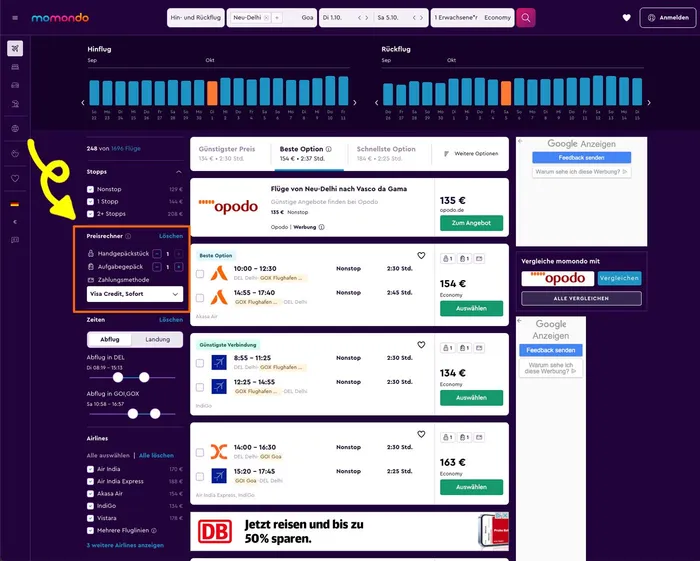
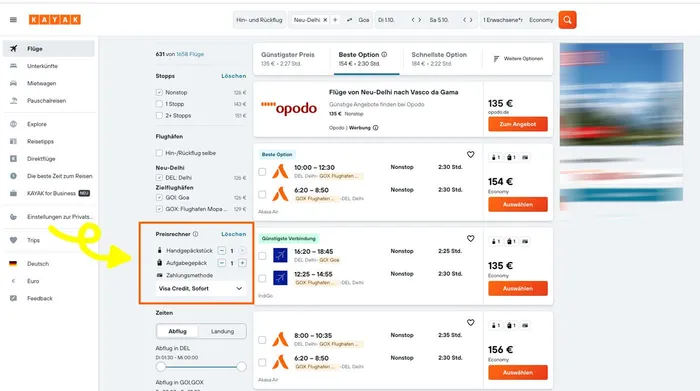
A personal tip: Always use several search engines side by side. Prices often vary between platforms, and comparing them makes sure you get the best deal. On one of our recent trips, using several search engines helped us find a flight from Frankfurt to New York for under 300 €. A real bargain!
In short: by using the strengths of different flight search engines and making the most of their filters, you greatly increase your chances of finding cheap flights. Don’t stick to just one search engine. The range of options can save you a lot of money.
Another alternative: Skyscanner
On Skyscanner you can view prices for whole months. Like the search engines above, it also lets you exclude certain airlines directly in your search.
Update: You can finally tell Skyscanner whether you’re flying with carry-on only or checked luggage too. This option was missing for a long time and made prices look cheaper than they really were.
 Finding cheap flights with Skyscanner
Be flexible with your travel dates
 Flexible travel dates often save a good part of your budget
Flexibility with your travel dates is one of the keys to finding cheap flights. Flights in high season are often much more expensive than in low season. If you can choose when to travel, avoid peak season and pick quieter times instead, such as the shoulder season or days like New Year’s Eve, Christmas or a Friday the 13th (no joke).
Another tip is to move your travel dates by just one day. Even a small change often leads to significant savings. I recommend avoiding weekend flights and generally travelling in the low season. This helps especially when you’re planning a longer trip. I know this isn’t possible for families with school-age children. I don’t have children.
A personal example: For a trip to Portugal we originally planned to fly on a Friday. By moving the flight to Wednesday we saved over 100 € per person. Small changes like this can make a big difference and are easy to do.
When to book flights: early, but not too early
Booking in good time is key to getting good prices. For flights within Europe, about 2 months in advance is usually enough, for long-haul flights about 2 to 3 months.
In high season, domestic flights are cheapest about four to six months in advance. For international flights you should book at least two months ahead to avoid rising prices. So plan your trip several months in advance and set up a price alert so you hear about price drops. These alerts help you find the best time to book.
I don’t trust any statistics. As soon as I know I’m flying somewhere, I check the prices regularly. With traditional airlines (Lufthansa, Delta, British Airways) it’s important to book early because demand is often high. With budget airlines, prices tend to go up the longer you wait. Last-minute bargains are rare.
My experience:
- We were planning a trip to South Africa
- We set up a price alert six months before our planned departure
- After about two months we got a notification about a significant price drop
- That let us book our flights for much less than the original price.
 Setting up a price alert for cheap flights
Check alternative airports nearby
An often overlooked tip is to use alternative airports near your departure point or destination. Flights to or from smaller airports can be cheaper. For example, it can be worth flying from Stuttgart instead of Frankfurt.
Most flight search engines let you add nearby airports to your search. This widens your options and helps you find potentially cheaper flights. Using this feature can save you a lot without straying too far from where you actually want to go.
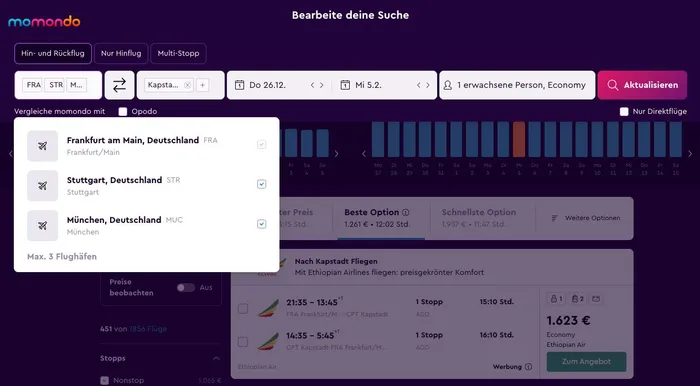
Another advantage of alternative airports can be cheaper rental car deals. This is especially useful if you plan to rent a car at your destination. A small detour to another airport can pay off twice.
An example from my own experience: On a trip to Italy we chose Pisa airport instead of Florence and not only saved on the flights but also got a cheaper rental car. This strategy is easy to use and helps you make the most of your travel budget.
For USA road trips I also recommend checking whether to start the West Coast in Los Angeles instead of San Francisco (or the other way round). In the South, try Nashville or Memphis as your starting point instead of New Orleans (and vice versa).
Use stopovers and open-jaw flights
Stopovers and open-jaw flights are great ways not only to save money but also to see more of the world. They let you visit several destinations on one trip, which is often cheaper than direct flights. With an open-jaw flight you don’t need an extra flight or a long bus ride back to where you arrived, which gives you more flexibility when planning your trip.
Open-jaw flights can be up to 50 % cheaper than two separate one-way flights. This option makes particular sense for trips through large countries or across several countries. You don’t have to return to your starting point at the end of the trip, which is more convenient and often cheaper. That makes them a good alternative to budget flights for these kinds of trips.
These flights are ideal for road trips (in German), because they give you more flexibility and let you explore different places in a country in more depth. One variation is the double open-jaw, where both the departure and the arrival airports differ, for even more variety on your trip.
A personal tip: On a trip to New York we used an open-jaw flight that took us from Frankfurt to Philadelphia (in German). We explored the city (highly recommended) and then took the train to New York. We also spent one night in New Jersey (in German) so we could fly home from Newark. That way we discovered two more places and saved money as well. The trip was not only cheaper than direct flights to New York, it also let us see more of the USA.
Compare airlines directly
Booking directly with the airline often comes with extra benefits. As a member (Miles & More, for example) you’ll often find special online deals on airline websites that aren’t listed in flight search engines. These exclusive discounts and promotions can save you a lot.
Booking direct definitely gets you better customer service when something goes wrong or a flight is cancelled. I could tell you all about my troubles with Lufthansa (a flight to Iceland moved by one day, a cancelled flight home from Bilbao, a delay of more than 4 hours to Oslo). All of this happened in the past few years.
Another advantage is that the airline’s website is sometimes cheaper than the flight search engines. Booking directly with the airline can also come with extras that third-party sites don’t offer.
Advantages of booking direct:
- Better customer service when there are problems or changes
- Possibly cheaper prices than on flight search engines
- Extras that third-party sites don’t offer
- Redeeming miles and getting upgrades is easier
Example of booking with the airline: I booked my direct flight to Japan directly with Lufthansa, even though I flew with ANA. The reason: Lufthansa showed the cheaper price and I could pay part of it with miles (Miles & More Gold credit card).
These days the Miles & More credit card is hardly worth it anymore. I only use the American Express Platinum Card (read my experience, in German) and prefer to transfer my points to KLM/Air France, Qatar or other airlines that are simply more reliable.
In short: Comparing prices on flight search engines and on airline websites helps you find the best deals and enjoy extra benefits. I really like booking direct, especially after the incidents above. Booking through Opodo would have caused me more trouble.
Take advantage of error fares
Error fares are a great way to get extremely cheap flights. These pricing mistakes are usually caused by human or technical errors, such as a missing zero or the wrong fare being applied. It’s important to book quickly, though, because these errors are usually fixed fast.
You can find error fares on deal blogs or by searching online. An important tip: don’t call the airline after booking so you don’t draw attention to it. Wait until your e-ticket is confirmed before making any other bookings, such as accommodation or visas. Here are a few useful tips and tricks to get the most out of your search.
Error fares for economy tickets are more likely to be honoured than those for business or first class. If the booking is cancelled, you usually get your money back. Flexibility pays off here, because these deals need to be booked fast.
Where to find error fares and flight deals:
Clear your cache and cookies
An often overlooked but important tip is clearing your browser cache and cookies before searching for flights. Repeated searches can make prices go up, because the site recognises that you’ve already looked at flights.
All providers claim this trick doesn’t work. That isn’t always true.
By deleting old cookies you make sure you see the best prices and that repeated searches don’t push the price up. It’s a simple but effective way to always see the best deals.
A tip: Clear your browser cache and cookies regularly, especially when you’re searching for flights. This can stop prices from rising because of your earlier searches and helps you find the cheapest deals.
Another trick is to change your location with a VPN.
Subscribe to airline newsletters
Newsletters from airlines and travel websites are an excellent source of exclusive deals and information. When you sign up, you get regular updates about premium travel experiences, extra offers or competitions. This helps you spot flight bargains you might easily miss otherwise.
Another advantage is that you often hear early about upcoming sales and special promotions. That gives you the chance to be one of the first to book and get the best deals. A tip: Create a separate email address for newsletters to keep your main inbox clean without missing any important offers.
An example from our own experience: Thanks to an airline’s newsletter we heard about an exclusive deal for return flights including carry-on luggage for under 100 € to a popular destination. That information helped us grab a fantastic deal.
Or, as I’m typing these lines, an email lands in my inbox:
 Flying for less thanks to airline newsletters
Use rewards programmes and miles
Rewards programmes and frequent flyer miles are an excellent way to save money in the long run. Many credit cards offer points or miles programmes that you can transfer to frequent flyer programmes such as Miles & More. You can then use these miles to pay for flights or get upgrades.
It’s worth paying all your bills with a credit card that earns miles or points (American Express Platinum or the Amex Payback card). In some cases this adds up to big savings and can get you free flights.
For me there is no better credit card than the American Express Platinum. There are alternatives, though. What matters is where you fly and with which airline. Star Alliance? Then Miles & More is the best deal if you live in Germany. Do you often fly from Berlin? Then take a look at the AMEX, because it makes it really easy to transfer miles to Etihad, Qatar Airways (the best airline for me), Turkish Airlines and other airlines.
Keep in mind that miles often expire after a certain time and that fees apply even to “free flights”. It’s important to know the terms and conditions of the frequent flyer programmes so you get the most out of your miles.
Unfortunately, collecting miles with the Revolut credit card (in German) no longer works. Miles & More had a problem with it.
Searching for flights with AI
Many flight sites now have their own built-in AI assistant. I don’t use them, and to be honest, I find them awful. When I use AI to search for flights, I ask ChatGPT or Claude directly.
For example, I ask:
My prompt: “Find me the best flight connections from [airport] to [destination] on [date]. I prefer flying with [airline or miles programme].”
The airline part matters to me. I no longer like flying with Lufthansa, and I have status with KLM and Air France. With my American Express Platinum Card I can transfer points to many airlines, but hardly any in Star Alliance. That way I get connections where I can earn or redeem miles.
Claude and ChatGPT search directly in my browser. I still check the prices myself before I book.
This is what a sample search from Frankfurt to Buenos Aires looks like:
 The AI’s recommendation: the order in which it would search
 Award prices in miles to Buenos Aires as seen by the AI, availability not confirmed
Summary
All in all, there are many ways to find cheap flights and save on your travel budget. From using different flight search engines and being flexible with your dates to error fares and rewards programmes, each of these methods can help you get the best deals.
In the end it takes a bit of planning and flexibility, but it’s well worth it. Use these tips to plan your next trip and save money along the way. With these strategies you’re well prepared to explore the world without breaking the bank. Of course these are only tips, there’s no guarantee of cheap flights. Good luck, be patient and happy travels!
PS: I’ve been looking for a deal on a direct flight to Cape Town for 7 months. Between Christmas and New Year’s Eve these flights have never been under 1,000 euros. And prices keep rising. Since I’ve already spent New Year’s Eve in my favourite city several times, I know I have to start saving for the next trip as soon as this one is over.
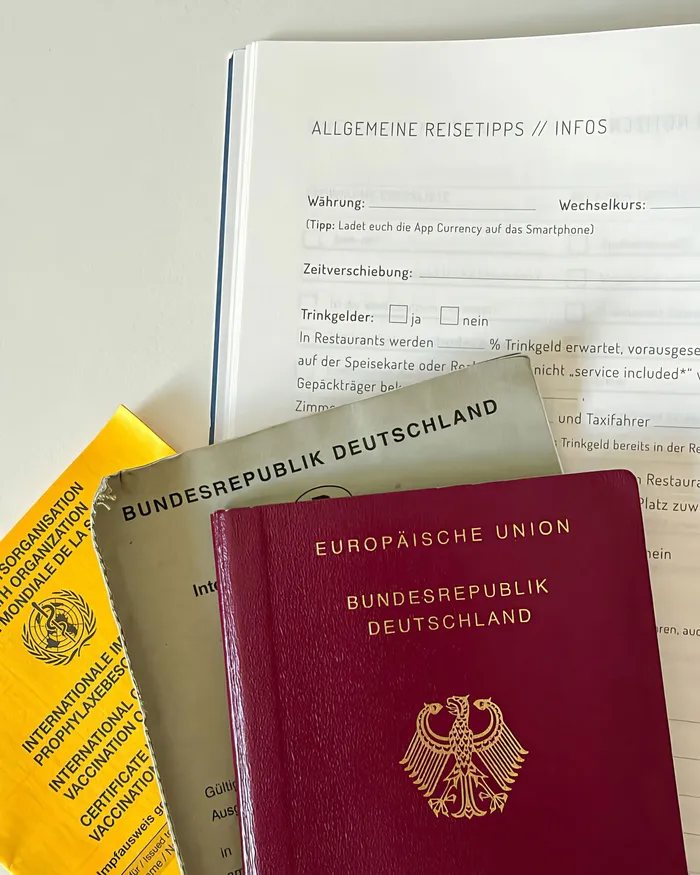
How to plan a trip: tips & tricks for travel planning
You finally want to go, but don't know where to start with the planning? Here I share the tips and lessons from more than 10 years of planning my own trips, so you save time, nerves and money.
The best places to travel each month

The best credit card for travel

Travel packing list: checklist for 1 week, 10 days & 3 weeks
City passes: my tested city pass comparisons

The travel insurance you really need

Booking a rental car: all my tips & tricks
Frequently asked questions
Which flight search engines are best for finding cheap flights?
The best flight search engines for cheap flights right now are Momondo and Google Flights, thanks to their filters and flexible search options.
When is the best time to book flights?
For flights within Europe, about 2 months in advance is usually enough, for long-haul flights about 2 to 3 months.
How can I save money by using alternative airports?
Use flight search engines and add smaller airports nearby to your search. This often turns up cheaper flights and helps you save money.
What are error fares and how do I find them?
Error fares are pricing mistakes that make tickets far too cheap. You can find them on deal blogs, in Facebook groups or by searching online. It’s worth checking regularly so you spot these mistakes and get cheap flights.
How can I make the most of frequent flyer miles?
Collect points with credit cards or frequent flyer programmes and use them for flights or upgrades. Keep in mind that miles expire and that extra fees may apply.
Useful links: my recommendations, this is where I book
If you book your trips or gear via my links, I receive a small commission. That’s how you can help me finance this travel blog (tech & hosting). Thank you for your support and for being part of my community. Thank you so much!